I am asked a lot what scheme will I be going for.
I had a free trial of the kerboodle online resources and was pleased with the quizzes and the idea behind how they work, but I was less impressed with the worksheets. Too much paper and not enough to make a lesson from. I feel that the lesson resources really missed the point. I did think that the questions they contained were good, and there were some strong links to contexts.
I knew then that buying kerboodle would not be enough. Luckily a copy of exploring science was sent out at this point. I wasn't exactly pleased that I was unable to find my school on the Pearson website and I had to make a phone call for Pearson to realise that we existed. I felt sorry that the reps that found me were not going to get the business. However, I have always found the worksheet resources for exploring science useful. So we have bought the worksheets from Pearson too.
I did look at the Collins resources and thought that they could have been more imaginative and really what I was buying was more of the same. The Hodder 'progress science' resources didn't do it for me either. I wanted something different.
However, I did buy "better teach science" by Hodder. These activities seem very imaginative and are linked to a context. Something that I couldn't do myself.
I hope that all these resources can compliment what we have an help to build a strong key stage 3 curriculum that helps students understand science.
For those of you who will criticise me for not writing our own and buying *worksheets*, we are a department of 6, only 3 of whom teach key stage 3. And more than that I want to explore the interactive resources that the publishers now offer. I will subscribe to the new exploring science textbooks in September, the interactivity in them looks amazing and is something that I could not hope to do to such a level and in such quantity.
I continue to strive to a 'perfect' key stage 3 scheme, aware that none of the published schemes are quite it.
The cost for what I recommend is upwards of £1600.
Showing posts with label key stage 3. Show all posts
Showing posts with label key stage 3. Show all posts
Friday, 13 June 2014

Saturday, 31 May 2014
The Changes to Physics NC 1999 to 2014
Electricity and Magnetism


I think that the new national curriculum does show an increased ambition for students.
There is specific reference to potential difference and resistance as well as V=IR in the new curriculum. However, I imagine that most schools are similar to the ones I have worked in and teach potential difference as part of key stage 3, and the concept of resistance as something that opposes the current flowing. The extra activity will involve the students calculating resistance. We have fixed resistors with small values, that will be useful for this type of activity.
Static electricity is new, but I don't think that this will take a lot of time to teach. Students are familiar with static electricity and the national curriculum doesn't expect them to understand earthing as a concept. If students have studied magnetism previously then the idea of 'opposites attract' should sit comfortably. They may also be aware of electrons as a concept from current electricity, if this has been introduced.
Magnetism has been increased to include compasses, but these are usually part of schemes anyway, so won't be a departure. Including the motor as an application of electromagnetism is a bit different and will require adaptation of resources, but I don't believe that it will require more of a challenge than teaching the door bell or speaker.
Forces and Motion


Looking at each section in turn, using the speed = distance / time equation isn't new, although distance-time graphs seem to be, they are currently taught at key stage 3. The new section seems to be relative motion.
In the forces section, there aren't many areas that are not currently taught, except perhaps work done and energy changes on deformation. I am interested to know what this should look like, and whether it should be approached in the forces topic, energy topic or both.
We already teach Hooke's Law in Year 7, but it is more about developing the ability to draw a line of best fit and interpolate from a graph than about recognising when a material obeys Hooke's Law. Air resistance is taught in Year 9. Most schemes of work I have taught have also covered the difference between contact and non-contact forces, so schools may already have resources to cover these curriculum points.
Pressure in liquids is not explicit in the 1999 curriculum, but this is taught in schools, so again should not be a stretch to develop lessons for.
Waves


The obvious addition is the mention of waves in water. As we use water waves to teach about light, I can see that this can be added into light topics. In the QCA schemes light came before sound, but teaching sound first, then light and water and finally being able to compare the three would be useful. That water waves are light light and transverse, but also like sound in that they need a medium to travel in.
I have never taught the pin hole camera before (although I have made and used a 'real' one in an extra curricular activity run by one of the technology teachers), it is part of some schemes however.
The human eye is something that I have not taught at key stage 3 before. As I write this I am wondering what level of detail I will go into about how the eye works; will I mention long and short sightedness for example?
The word frequency appears in the new national curriculum. I don't usually ensure that students understand that different colours have different frequencies. I think this is because I don't usually teach light as a wave, I teach more about the properties of light and what it does. Teaching that light is a wave introduces some new questions for the learner - what is it that is vibrating? Light doesn't wiggle, it is a straight line.
Space Physics


This is the area where information seems to have been stripped out. Satellites haven't been included.
Although the seasons and day length were not included in 1999, but were taught in the QCA schemes, and I also think I have seen SATs questions about day length and the movement of of the sun across the sky. I note that the planets are not explicit in either curriculum.
Energy


Energy is the bit that needs work. I am not entirely sure how I will include 'simple machines'. Physics for you will help, I hope. I am also undecided of how to approach kWh as a unit of energy.
The issue with physics is that we need to teach transfer instead of teaching transformation. Reading work by Robin Millar is a good place to start. e.g. http://www.york.ac.uk/media/educationalstudies/documents/research/Paper11Teachingaboutenergy.pdf and http://esummit-msu.net/users/robin-millar
Teaching food energy, energy resources, and heating and cooling is something covered in previous schemes of work. It is interesting that convection is not explicit in the new national curriculum. I think that it is something worth teaching to recap the idea of density and prepare students for GCSE, where it will be necessary to help understanding of how insulation works.
Power is an interesting addition. I know the OUP scheme from the early 2000s covered it, so there are resources available.
Matter
The new addition is the reference to matter.


It will be interesting to see the ways that schools and publishers approach this. I would prefer to teach the particle model in Year 7 chemistry and then use physics contexts to revisit the ideas. In that way we will cover the concepts written in the national curriculum, without needing to add another topic that recaps the ideas already taught in chemistry.
For example, Brownian motion will be taught in air pressure, change of state will be taught as part of the heat energy topic as well as the changes to the spacing of particles as temperature changes. Density will be taught in floating and sinking, etc etc.
Hopefully these observations will help someone. I will try and do the same things for biology and chemistry.
Friday, 30 May 2014
My Ideal Scheme of Work (1) Giving it Purpose
It is not a secret that I love the Segue schemes of work. My ideal schemes of work would be built on the some of the same principles from the Cracking Science manifesto of Tony Sherborne.
Please see: http://www.upd8.org.uk/wikid-tick.php
Through experience I agree with the idea of having big ideas as themes through schemes of work; adding to the ideas of the students, nudging and supporting them in building their ideas about science. I want to go back to the 'Principles and Big Ideas of Science Education' document on the ASE website to work out what those big ideas are. I was not always confident that the 5 big ideas of the old key stage 3 strategy are the best choices. However, I did always use them in my teaching, e.g. student study particles in Year 7, develop this in the Solutions topic, recover the basics again in the sound and heating topics in Year 8 and again in the pressure topic of Year 9. This only scratches the surface, the ideas interweave throughout science and this revisiting of the ideas can only help students to remember and understand ideas about science.
Using these key ideas it is possible to help students make links between the concrete knowledge of the student to abstract ideas, allowing them to use what they know to explain things they don't. As real scientists do.
In the cracking science manifesto, Tony Sherbone mentions the term 'backwards design'. It is something that I am familiar with. When working with a team in London in February we outlined what we want from key stage 3. We need to work back from this to ensure that the opportunities for students to develop the skills (knowledge was only a small proportion) are part of the schemes.
Following this starting point, Ed Walsh (leaning heavily on the work of Robin Millar) has convinced me that having a 'working scientifically' objective alongside the content objective is the best way to teach the skills and knowledge that students need from science education. This is what the upd8 schemes have.
I also agree that the teacher has to motivate the learners. In science this is important to inspire the next generation of scientists.
I like the 5/7E lesson cycle, I believe that it has the potential to engage students both intellectually and emotionally in their work. The idea of engaging students with a question in context helps students to engage in the lesson and give it purpose. Starting with an engaging problem also helps to give the end of the lesson clarity. The elaborate section is my favourite bit, the plenary of the lesson and it usually gives the chance to assess the student formatively and build their literacy skills.
I have written about it before. In my ideal world all my lessons would be structured this way, but it takes time to think about it especially when it also needs to be fitted to the GCSE curriculum. However, I don't see why my KS3 lessons can't have this structure, upd8 wikid and segue prove that it is possible.
The criticism of the wikid schemes was that the students got too wrapped up in the stories. In my ideal scheme of work I would try to make the 'story' more real. It may curb the excitement, but hopefully it will help students find out more about real science discoveries.
I also want to think about how new technology can change the way that students will learn. Our students will have an iPad each. (Or should have). Watching videos, researching using the web, working on collaborative documents, answering online quizzes, writing blogs, creating graphics, auras and videos should all be possible. Alongside developing future scientists and scientifically literate young people I have the added responsibility of helping students get to grips with ICT, and using it to help them learn. I want to develop a scheme of work that also makes the most of this new technology.
I want to develop a scheme of work that
a) starts with the end in mind,
b) interweaves the big ideas of science throughout, building a progression in understanding from concrete to abstract models in these areas
c) has learning objectives that reference working scientifically and knowledge for each lesson
d) is emotionally engaging for students by including a context and/or story for lessons or sets of lessons
e) is made up of lessons that are structured using the 5E lesson cycle
f) makes use of new technologies to support the learning of students and helps them develop ICT skills
g) most importantly helps students to see that science is relevant to their every day lives and is a subject worth following as it is for everyone.
Please see: http://www.upd8.org.uk/wikid-tick.php
Through experience I agree with the idea of having big ideas as themes through schemes of work; adding to the ideas of the students, nudging and supporting them in building their ideas about science. I want to go back to the 'Principles and Big Ideas of Science Education' document on the ASE website to work out what those big ideas are. I was not always confident that the 5 big ideas of the old key stage 3 strategy are the best choices. However, I did always use them in my teaching, e.g. student study particles in Year 7, develop this in the Solutions topic, recover the basics again in the sound and heating topics in Year 8 and again in the pressure topic of Year 9. This only scratches the surface, the ideas interweave throughout science and this revisiting of the ideas can only help students to remember and understand ideas about science.
Using these key ideas it is possible to help students make links between the concrete knowledge of the student to abstract ideas, allowing them to use what they know to explain things they don't. As real scientists do.
In the cracking science manifesto, Tony Sherbone mentions the term 'backwards design'. It is something that I am familiar with. When working with a team in London in February we outlined what we want from key stage 3. We need to work back from this to ensure that the opportunities for students to develop the skills (knowledge was only a small proportion) are part of the schemes.
Following this starting point, Ed Walsh (leaning heavily on the work of Robin Millar) has convinced me that having a 'working scientifically' objective alongside the content objective is the best way to teach the skills and knowledge that students need from science education. This is what the upd8 schemes have.
I also agree that the teacher has to motivate the learners. In science this is important to inspire the next generation of scientists.
Emotionally engaging the student in the learning journey, either by helping them overcome a challenge or through relevant activities and contexts. I like the question asked 'why should I care?' Actually, "because it will help you get GCSEs in the future and this is a compulsory subject" isn't helpful, because we have to do more, we have to help students to see that science is an important part of their lives, because it is!
- We have achieved Motivation To Learn when students find meaning and purpose in science. Unfortunately, it is clear from research into students' attitudes (as well as low uptake of science subjects) that too many view science as 'important, but not for me'.
I like the 5/7E lesson cycle, I believe that it has the potential to engage students both intellectually and emotionally in their work. The idea of engaging students with a question in context helps students to engage in the lesson and give it purpose. Starting with an engaging problem also helps to give the end of the lesson clarity. The elaborate section is my favourite bit, the plenary of the lesson and it usually gives the chance to assess the student formatively and build their literacy skills.
I have written about it before. In my ideal world all my lessons would be structured this way, but it takes time to think about it especially when it also needs to be fitted to the GCSE curriculum. However, I don't see why my KS3 lessons can't have this structure, upd8 wikid and segue prove that it is possible.
The criticism of the wikid schemes was that the students got too wrapped up in the stories. In my ideal scheme of work I would try to make the 'story' more real. It may curb the excitement, but hopefully it will help students find out more about real science discoveries.
I also want to think about how new technology can change the way that students will learn. Our students will have an iPad each. (Or should have). Watching videos, researching using the web, working on collaborative documents, answering online quizzes, writing blogs, creating graphics, auras and videos should all be possible. Alongside developing future scientists and scientifically literate young people I have the added responsibility of helping students get to grips with ICT, and using it to help them learn. I want to develop a scheme of work that also makes the most of this new technology.
I want to develop a scheme of work that
a) starts with the end in mind,
b) interweaves the big ideas of science throughout, building a progression in understanding from concrete to abstract models in these areas
c) has learning objectives that reference working scientifically and knowledge for each lesson
d) is emotionally engaging for students by including a context and/or story for lessons or sets of lessons
e) is made up of lessons that are structured using the 5E lesson cycle
f) makes use of new technologies to support the learning of students and helps them develop ICT skills
g) most importantly helps students to see that science is relevant to their every day lives and is a subject worth following as it is for everyone.
Monday, 19 May 2014
Bought Schemes of Work: I expect more
So, I am currently reviewing key stage 3 schemes of work. I have to say that I am not that impressed.
I am in a very fortunate position of not having to worry as much as someone who works in a state school about progress, evidence and monitoring. There isn't a half termly email demanding a progress report. My SLT use the grades we give in the reports we write as that evidence. (Which we do October, December, March and June).
This means that I am looking for a scheme of work with an engaging book, good support materials for the technicians and creative activities. I am really struggling to find it.
Making a poster, answering a 6 mark question (which I could have made up myself), closed question sheets, make a model, fill in the labels on the diagrams, create a presentation with ideas about X on slide 1 and Y on slide 2 etc. Questions like 'write down the names of 10 elements'. Worksheets that require students to write in boxes with no lines, (especially when they could be writing in their books and using the worksheet as a reference and saving paper).
I want more.
I want activities that inspire the students, I want contexts, I want a lesson where the activities tie together, I want lessons that build on the one before, I want something I could not do myself. Apart from the typesetting, I haven't seen this. I want links to real scientists, I want every day applications, I want data, I want examples of good and bad investigations and modelling of good practice when drawing graphs.
I don't want the students to know what onion cells look like before they look at them down the microscope, I don't want them to know acid and bicarbonate is going to fizz before they add them together. I don't want them to know a spring is going to obey Hooke's Law before they stretch it.
But I want something that a) needs more than a few months to put together and b) costs more than I am willing and able to pay.
The cheapest available course it is then.
I am in a very fortunate position of not having to worry as much as someone who works in a state school about progress, evidence and monitoring. There isn't a half termly email demanding a progress report. My SLT use the grades we give in the reports we write as that evidence. (Which we do October, December, March and June).
This means that I am looking for a scheme of work with an engaging book, good support materials for the technicians and creative activities. I am really struggling to find it.
Making a poster, answering a 6 mark question (which I could have made up myself), closed question sheets, make a model, fill in the labels on the diagrams, create a presentation with ideas about X on slide 1 and Y on slide 2 etc. Questions like 'write down the names of 10 elements'. Worksheets that require students to write in boxes with no lines, (especially when they could be writing in their books and using the worksheet as a reference and saving paper).
I want more.
I want activities that inspire the students, I want contexts, I want a lesson where the activities tie together, I want lessons that build on the one before, I want something I could not do myself. Apart from the typesetting, I haven't seen this. I want links to real scientists, I want every day applications, I want data, I want examples of good and bad investigations and modelling of good practice when drawing graphs.
I don't want the students to know what onion cells look like before they look at them down the microscope, I don't want them to know acid and bicarbonate is going to fizz before they add them together. I don't want them to know a spring is going to obey Hooke's Law before they stretch it.
But I want something that a) needs more than a few months to put together and b) costs more than I am willing and able to pay.
The cheapest available course it is then.
Wednesday, 2 April 2014
I can't live without levels
I am trying to map out progression through the working scientifically ideas, I can't do that without looking back at the work that has gone by on levels and APP.
I can't help thinking about progression of students as being in levels or stages. I can't help but think that there are levels of difficulty in tasks and levels of outcomes to activities.
I have an idea about what I want my students to be able to do at the end of Year 9. How do I get them from the level they are at when they start Year 7 to the level I want them to be at the end of Year 9, but by a series of steps or levels?
I can't help thinking about progression of students as being in levels or stages. I can't help but think that there are levels of difficulty in tasks and levels of outcomes to activities.
I have an idea about what I want my students to be able to do at the end of Year 9. How do I get them from the level they are at when they start Year 7 to the level I want them to be at the end of Year 9, but by a series of steps or levels?
Sunday, 7 April 2013
Proposed Changes to the National Curriculum 2: chemistry
My previous post looked at the key stage 3 biology section of the proposed national curriculum from 2015. In this one look at the chemistry section of the key stage 3 curriculum. Again I compare it to the 1999 national curriculum as this is the one that we use in my school because we follow the QCA units.
The images with orange headings are from the 1999 curriculum and the blue headings are from the 2015 proposed curriculum.
I have found the chemistry national curriculum a lot harder to compare directly from 1999 to 2015.
The main omissions are the sedimentary, metamorphic and igneous rocks, the concept of conservation of mass during chemical and physical changes, the relationship between temperature and solubility, carbonates also seem to be missing.
The additions include studying the atmosphere, and "ceramics, polymers and composites" (for such a little sentence this opens up a vast section of chemistry), endothermic and exothermic reactions and using carbon to extract metals from their oxides.
Currently I have to decide if we should change the earth science units taught in year 8 and perhaps move the 9G and H units in order that we can fill in the areas that the students will have missed on polymers and ceramics. I will look at the key stage 4 curriculum before deciding.
Please do comment if you see something that I have overlooked.


ATOMS, ELEMENTS, COMPOUNDS AND MIXTURES


The mixtures aspect of the proposed 2015 national curriculum seems similar to the 1999 national curriculum. And it is the first time that experimental techniques are mentioned in the chemistry section. I don't disagree with the idea of defining what a pure substance is - I teach this as part of 7H, so including it explicitly won't cause an issue. What is missing is the relationship between solubility and temperature and the emphasis on understanding solutions, as well as the conservation of mass.
EARTH SCIENCE


I don't think that the proposed 2015 national curriculum presents much of a change to the reactions of acids. Although the last statement needs to be corrected to show that when acids react with metals a salt an hydrogen (not water) is formed.
The images with orange headings are from the 1999 curriculum and the blue headings are from the 2015 proposed curriculum.
I have found the chemistry national curriculum a lot harder to compare directly from 1999 to 2015.
The main omissions are the sedimentary, metamorphic and igneous rocks, the concept of conservation of mass during chemical and physical changes, the relationship between temperature and solubility, carbonates also seem to be missing.
The additions include studying the atmosphere, and "ceramics, polymers and composites" (for such a little sentence this opens up a vast section of chemistry), endothermic and exothermic reactions and using carbon to extract metals from their oxides.
Currently I have to decide if we should change the earth science units taught in year 8 and perhaps move the 9G and H units in order that we can fill in the areas that the students will have missed on polymers and ceramics. I will look at the key stage 4 curriculum before deciding.
Please do comment if you see something that I have overlooked.
Chemistry
SOLIDS, LIQUIDS AND GASES (PARTICLES)


The first statement in the 1999 KS3 chemistry section talks about classification of materials and interestingly as classification has gone from biology it also seems to be missing from chemistry too.
I wonder if using the melting and boiling points to work out the state of a material would still be expected even though it is no longer explicit, (see below) we still have to teach the physical properties of the elements.
There are glimpses if you look at the "periodic table" section of the 2015 national curriculum.

However, in the new national curriculum only the properties of the elements are considered and not materials in general. And the last statement about "with respect to acidity" does that mean how they react with acid, their pH, or both?
The particle theory seems to be very similar, the energy changes involved in state changes was present in the 1999 national curriculum. And we do already teach that the particles move/vibrate according to their state.

ATOMS, ELEMENTS, COMPOUNDS AND MIXTURES


The mixtures aspect of the proposed 2015 national curriculum seems similar to the 1999 national curriculum. And it is the first time that experimental techniques are mentioned in the chemistry section. I don't disagree with the idea of defining what a pure substance is - I teach this as part of 7H, so including it explicitly won't cause an issue. What is missing is the relationship between solubility and temperature and the emphasis on understanding solutions, as well as the conservation of mass.
EARTH SCIENCE


The change to the Earth Science section of the key stage 3 national curriculum seems to be the greatest. I like teaching 8G&H.
However I am pleased to see global warming and the atmosphere being addressed at key stage 3, as well as recycling.
CHEMICAL REACTIONS

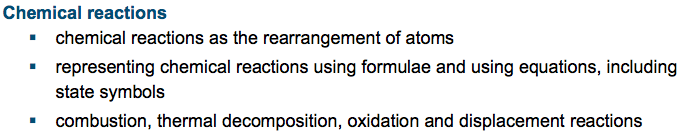
It is interesting to see that the statement about conservation of mass in a chemical or physical reaction is not present in the proposed 2015 national curriculum. It is an abstract idea, but something I like to cover as it is part the story of how oxygen was discovered.
Rather than give a general statement about how chemical reactions are useful in everyday life, the proposed curriculum lists those chemical reactions. I can't think of where thermal decomposition occurs in the QCA units, but the other types of chemical reaction we have to teach will not mean a big change.
EXOTHERMIC AND ENDOTHERMIC REACTIONS

This is new to key stage 3 national curriculum, but I believe that it is a part of the "using chemical reactions" QCA unit, so again does not represent a big change.
METALS AND MATERIALS

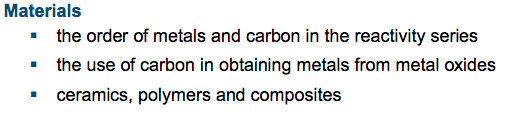

I think that the main change is including the idea of using carbon to extract metals from their ores. This is interesting when rocks have not been studied as part of the 2015 national curriculum, but perhaps this gives the potential to add the usefulness of rocks as a raw material.
ACIDS AND BASES

I don't think that the proposed 2015 national curriculum presents much of a change to the reactions of acids. Although the last statement needs to be corrected to show that when acids react with metals a salt an hydrogen (not water) is formed.
Monday, 9 April 2012
What should the aims of a key stage 3 science curriculum be?
After being asked by a colleague via twitter what the aims of a ks3 scheme should be I reflected that although I have complained within this blog about the quality of the key stage 3 schemes at my school I have not written anything about what the schemes should be like.
When considering what key stage 3 should develop in my students I wrote a list of skills:
Investigating skills -
Drawing a table
Calculating averages
Drawing graphs including, choosing scales, picking the right sort of graph, drawing a line of best fit
Identifying patterns in data and in graphs
Identifying anomalies
Following a procedures/methods
Choosing equipment
Identifying variables, including ones to investigate, measure and control and the language associated with variables and fair testing
Describe how to make an experiment a fair test
Carry out a risk assessment
Using measuring equipment appropriately
Recognising the value in repeats
Understanding the vocabulary especially reliable, reproducible, repeatable, precise, valid, fair, sensitivity, and range
Evaluating procedures
Evaluating data
Comparing primary and secondary data
Making predictions and hypothesises, generating questions to investigate
Construct arguments/conclusion using evidence
Identify primary and secondary data
Communication skills -
Correctly using the language such as bias, theories, laws, principles,
Recognising bias in science articles
Using secondary sources
Identifying the work of a scientist and different types including how they work together
Describe how ideas can be developed
Use Internet and books to carry out research
And thinking skills - grouping, ordering, prioritising, classifying, identifying relationships, probability, using sizing, ratio, using abstract models
However, the vast majority of this can be found on the APP grid. (As much as this is disliked by many).
But just developing skills is not enough in my opinion. You also have to engage students in science, help them see the relevance to their every day lives. Future morph has great ideas relating science to our every day lives and sources for this, for example: http://www.futuremorph.org/teachers/viewitem.cfm?cit_id=4834
It is also vital that students get an idea of what science can and can't do; what is meant by science enquiry; and that science idea evolve and change as more evidence comes to light. To often science is taught and thought of as absolute truths, when in reality it is evolving.
- Posted using BlogPress from my iPad
When considering what key stage 3 should develop in my students I wrote a list of skills:
Investigating skills -
Drawing a table
Calculating averages
Drawing graphs including, choosing scales, picking the right sort of graph, drawing a line of best fit
Identifying patterns in data and in graphs
Identifying anomalies
Following a procedures/methods
Choosing equipment
Identifying variables, including ones to investigate, measure and control and the language associated with variables and fair testing
Describe how to make an experiment a fair test
Carry out a risk assessment
Using measuring equipment appropriately
Recognising the value in repeats
Understanding the vocabulary especially reliable, reproducible, repeatable, precise, valid, fair, sensitivity, and range
Evaluating procedures
Evaluating data
Comparing primary and secondary data
Making predictions and hypothesises, generating questions to investigate
Construct arguments/conclusion using evidence
Identify primary and secondary data
Communication skills -
Correctly using the language such as bias, theories, laws, principles,
Recognising bias in science articles
Using secondary sources
Identifying the work of a scientist and different types including how they work together
Describe how ideas can be developed
Use Internet and books to carry out research
And thinking skills - grouping, ordering, prioritising, classifying, identifying relationships, probability, using sizing, ratio, using abstract models
However, the vast majority of this can be found on the APP grid. (As much as this is disliked by many).
But just developing skills is not enough in my opinion. You also have to engage students in science, help them see the relevance to their every day lives. Future morph has great ideas relating science to our every day lives and sources for this, for example: http://www.futuremorph.org/teachers/viewitem.cfm?cit_id=4834
It is also vital that students get an idea of what science can and can't do; what is meant by science enquiry; and that science idea evolve and change as more evidence comes to light. To often science is taught and thought of as absolute truths, when in reality it is evolving.
- Posted using BlogPress from my iPad
Location:Bristol, UK.
Subscribe to:
Posts (Atom)