Showing posts with label collaboration. Show all posts

Saturday, 29 December 2012

Pinterest

I have posted previously about pinterest.


I am enjoying using it, although I can find the mobile app a little restrictive and not as functional as using Pinterest in a full web browser.

Getting started (these are mobile app instructions)


Sign up or sign in, depending on whether you have an account already.

When I sign in I am presented with this, or something similar:


If you do not follow anyone this space will be blank.

The menu to help navigate is on the top left. Click it and click search.


I find that connecting to people I am interested in using pinterest is so much more difficult than on twitter, facebook, google+ and tumblr. However, following people is really useful as you can share ideas easily.

The search allows you to find boards, pins and people of interest. By searching by board you can inadvertently find people you might like to follow.


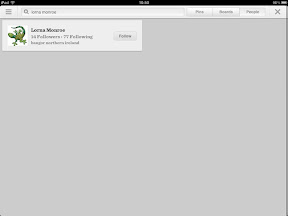
I searched for someone I know, Lorna. She has some great science education related pins.


You can also use the menu to search for education related pins/images.


I often look through these pins. I find them based on primary education, but there is often a gem or two. If I find an image that I like the look of then I can "like" it, "share" it, or "repin" it.


Click on the image you want to repin/like/share and it will increase in size.


I decided to repin this image, so clicked on the repin button.

My images are divided into "boards", usually with the name of the units I teach, but also some more generic ones such as literacy, how science works and funny. I want to pin this image to "literacy" and not "funny".


So I click on the button that allows me to select the board to pin to. A draw pops out and I can scroll to find the appropriate board, or even create a new one.


Before I click on the red button to pin it to my literacy board it is possible to change the notes at the bottom describing the pin.

I am also able to add a comment and see who else has repinned that particular image/pin. These users might be people I would like to follow if they have similar interests. I can also add a comment to the pin.


You do not have to follow all the boards from a particular user. For example discovery education. I am not interested in "arts and crafts" so I only follow the "science board". I don't want my home page to be filled with pins that are not relevant to me.


To upload a pin using the mobile app it is easiest to have the image already saved to your mobile device. Use the menu and select camera. Then choose the image you want to upload, which board to upload it to and add a comment.


I think pinterest has massive potential I helping to share resources and ideas in education.

Happy Pinning!

- Posted using BlogPress from my iPad

Wednesday, 4 April 2012

Using Simulations in the Classroom

Due to the AFL strategies and observation foci I am well aware of how I should be using questioning in the classroom; aware of how I should be making learning outcomes clear and comment marking; I am also aware that I should have a variety of activities to engage the Learners. I am also in the process of considering the effectiveness of practicals in lessons as there is some degree of thought that a well designed demonstration is more helpful to learning than a practical.

However, I have never considered the effect and advantages of using simulations. Until now.

I have been involved in a project run by the science learning centres and Sheffield Hallam University, as part of which I have decide to use simulations more and see the impact.

Sheffield Hallam University kindly gave me access to sunflower learning for my students and myself. I used it with year 11 to look at split ring commutators and slip rings on the ac generators. The students accessed the software in a variety of ways. Some using the activities that you can set for the students, others just playing with the software without direction. Those that understood best were ones that I questioned and lead through the activities by my questioning. You can make your own resources for the students to use, and I expect that this would be my next step. It would help me and the students focus more closely on the learning objectives that I feel are best approached using the simulations instead of other teaching methods.

I have also used PHeT with year 12. This was to demonstrate the photoelectric effect. It took longer to log onto the computer than for the students to realise there is a threshold frequency. I wait to see if the students remember this experience more because they found out through a simulation.

Although the project has finished I want to continue to see the impact on my teaching and the learning of others of using simulations. My main issue is that at my current school we have access to laptops making it quick and easy to use a simulation as an activity in a lesson. At my new school I will have access to a computer lab, but using computers for 20 minutes of a lesson is going to be as practical.


- Posted using BlogPress from my iPad

Monday, 2 April 2012

Sharing Practice

I am fairly sure there is a page on our internal departmental SEF template that asks how we share practice. It is an excellent question. I am always made to feel a bit guilty when I write my answer as I know the truth is "not as well as we could be".

The first school I worked in had a small science staff room next to the prep room where we would sit at lunch and break. We would share our issues and ideas in a very candid way. The kids were hard work and any support was well received. The push in the school was for better teaching as the management believed that better teaching would mean better engagement, behaviour and results. This is true, but as staff we resented the insinuation that our poor teaching was the cause of all the problems within the school. However, the result was we discussed teaching and learning a lot and ideas and advice were shared freely.

Moreover, in the first school I worked in we had schemes of work and we shared all our resources, we were a team with only a few people on the outside keeping their ideas and resources apart from the rest of us.

In my second school we didn't have an area where we could meet at break and lunch. We stayed in our classrooms. The head didn't like the idea of staff congregating out of his knowledge (at least that was our opinion). We did have an AST though who would arrange training days to ensure we talked about assessment or group work. She ensured that the schemes of work were of excellent quality, with lots of different types of activity and levelled outcomes. This helped to share practice.

In this school, according to our SEF, I use the schemes of work to share practice and we have informal discussions. None of which is that true or particularly consistent when it does it happen. Too many barriers and not enough expectations. The only thing I regularly do is send emails out with ideas and links, or photocopy journal articles and give them to people I think might be interested. Not sure the recipients care, or take in what I send. No one send things back to me.

When I move to my forth I will be responsible for ensuring the faculty share ideas and act on what they learn. I will be the front. I need to get back in the habit of discussing learning and I need to make sure that the department act as a team following my vision and pulling together to help each other improve.

I intend to start with the scheme of work, make sure we include various ideas we have had in them. A "live" document. I also need to look at how we use departmental meetings, are we talking about where we store the clamp stands or something more useful? I know that my new school has policies on assessment, so using policies that support good pedagogy should also help share good practice.

I must use my time in the final term to find out about what goes on in my faculty and build trusting relationships with the staff I work with so that I can have discussions about what is happening in the classrooms without them feeling they are being judged.

I have been able to share in the successes of other teachers via twitter and I hope this will make me more open to giving and receiving ideas on the best practice of science teaching.

- Posted using BlogPress from my iPad

Tuesday, 20 March 2012

Using online conferencing software to engage in CPD

I have recently been involved in a CPD trial with the science learning centre using online software to connect with and speak to other teachers. We have been using adobe connect. From the end user point of view I really like it because it just works. The host sends a link, you click on it and it opens a user interface that allows you to see the other contributors, a presentation and contribute to a chat box. There is also a section that lists the contributors and allows you show symbols to agree/disagree, laugh, applaud or put your hand up to indicate that you want to make a contribution.

It is a very interesting experience to have a meeting online using adobe connect. It isn't possible for everyone to have their microphone open at once because the feedback from computers to microphones means that you hear echoes of the person who is speaking. This means that the meeting is ultra polite; we even have to raise our virtual hands to get a chance to speak.

The chat box is useful. It is like passing notes in a meeting but so everyone can see; a much more professional version of the bingo we might play during whole school in-service. It can get distracting for notes to go up on the screen while you are talking or listening, but we are now taking time at the end of each agenda point to read back over the written comments. After the meeting written comments (and a video of the meeting) are stored so we can refer to them, this is more useful than a normal meeting when you either have to make your own notes or remember what has been said.

Most of all though I like using the online video conferencing to meet with people I would never normally engage with. It is much easier to communicate face to face, even over the Internet, than by written format on a forum or in twitter. There is less room for misinterpretation I believe.

Our host Emily structures the meetings very carefully, and invites us all to contribute on each agenda point. Which I really like. It means someone like me can't push themselves forward and do a lot of talking at the expense of others. I can imagine that the success of using adobe connect depends a lot on the ability of the chairperson.

I don't know how easy adobe connect is to use as the presenter/host/chair, but I do think that there are a lot of positives, enough that if I had a group of schools spread out across a federation or LA I would use it to help connect the teachers and spread good practice.


- Posted using BlogPress from my iPad

Sunday, 11 March 2012

Organising a teachmeet

The ASE west subcommittee have decided to organise a teachmeet. This is doesn't seem that interesting as a lot of people do this and there is a teachmeet somewhere in the country at least twice per week in the term time. It does get quite interesting when you consider that only one of the organisers know what it is and what it entails. That organiser is me, and I am not one of the main ones responsibilities.

I heard about teachmeets where I hear about most things, on twitter. The first one I went to was at Clevedon School. It was a very positive evening with a wide variety of ideas shared by the presenters. I wouldn't say my world was set alight, but it was great to be in a room with so many positive people and that is something different.

So how do you get the idea of how a teachmeet runs and how to market it across?

In my case badly, firstly my colleague didn't use the teachmeet section on the wiki website to create the pages, he made his own wiki. Secondly we all struggled to make a logo naff enough to go on the teachmeet wiki and make it into a link to our pages. Thirdly advertising seems to have been forgotten and even our own committee members haven't signed up for the event yet!

Luckily, one of the other Field Officers has come to my rescue and sent a "how-to" document. It has included things that I haven't even thought about, like who to contact at the ASE to get the email around to members that it is happening, and to make sure there are signs directing visitors.

I have to take my hat off to everyone who manages to organise a successful teachmeet: It isn't straightforward or easy.


- Posted using BlogPress from my iPad

Tuesday, 24 January 2012

Using social bookmarking

I find or I am sent so many useful links to websites with great resources and ideas. But I am not always in a position to use them straight away for a variety of reasons.

I used to keep a word document of useful links. It wasn't easy to search and formatting was tricky. Now I use social bookmarking. I found out about it when reading an article in a teaching magazine. At first I just tried it, adding websites that I already know about and gradually my use has increased.

The site I use is called delicious. You can create "stacks" meaning it is even easier to keep related bookmarks together and browse them. I also have apps on the iPad that make it even easier to add and search the websites I have bookmarked.

As the resources available on the Internet expand social bookmarking is a great way to keep track of the useful things I have seen. Try it.


- Posted using BlogPress from my iPad

Thursday, 27 October 2011

Twitter and the PLN...

I come to blogging because of twitter. Many teachers on twitter have blogs and it is a very good way to share practice that cannot be described through 140 characters.

I had a twitter account for a long time before I started tweeting, but quickly got into it once I started following the right people. Now I follow anyone who is a teacher or trainee teacher and a lot of people who are related to education. Mostly I like to follow those in the UK, but there are a few very inspiring North American teachers who have twitter accounts too.

I have become good at filtering through the thousands of tweets in my twitter stream per day, usually only looking back over the past hundred or so. I can spot the avatar of the people and organisations that I am most interested in and tune into their tweets, gradually building up the people I follow has helped with this.

I believe that it took me a while to get into using twitter because I didn't know who to follow. I was trying to use the twitter recommendations and only found NASA and BBC news. Finding real people is much better.

So if I could only follow 10s of people instead of 1000, who would I follow?

@Bio_Joe
@Lethandrel
@cleverfiend
@Mr_D_Cheng
@NeedhamL56
@teachingofsci
@ViciaScience
@morphosaurus
@agittner
@asober
@57mason
@niamhirl
@maz_blaze90
@damianainscough
@DrDav
@Biolady99
@AnthHard
@deejbee
@cardiffscience
@Mallrat_uk
@123anatomy
@doc_gnome
@racheleppy

Would be my list of real people. They are all scientists and contribute to #asechat on Monday evenings.


There are another group who are ICT based and very much into blogging with their students. @ICTEvangelist, @ianaddison and @fraserspeirs would be a starting point.


There are also organisations on twitter. This is the part that I find the most useful: following what their latest ideas are and keeping up to date with the data being pushed to me rather than me having to look for it.

@STEMclubs
@Future_Morph
@RSC_EiC
@imascientist
@ScienceWeekUK
@TESScience
@GCSE_Science
@SAPS_News
@ScienceVoice
@ThePhySoc
@SciTeachJC
@scicast
@SexEdUKation
@planetscience
@OxfordEdScience
@ARKive

There are others, such as the department for education and the schools network. One can even follow Toby Young.

However, any science teacher new to twitter who starts with these lists should be able to build their "personal learning network" up quite easily from these starting points, and have no trouble in learning or re-learning something related to science education.

Monday, 24 October 2011

Five Year Plan for the ASE

I am a member of the ASE (association of science education). I joined because the advice and collaboration that existed during the time of the national strategies has dried up, but the need to change and re-interpret how we teach hasn't. I am never too proud to seek advice and guidance to ensure that I am giving my students the best possible science education I can.


The ASE has been around for nearly 50 years and the present moment in history is not its strongest. The ASE seems to have lost touch with its membership as the numbers slowly slip downwards. The current financial situation doesn't help.


It is vital at this time that the ASE is restructuring and thinking about the future, not just because its own survival depends on it, but also because science education needs a body to stand up for it and keep science education relevant for both the students and industry.


The chief executive of the ASE Annette Smith writes a blog to keep members up to date with news affecting science education and the ASE in general, http://www.ase.org.uk/news/ceo-blog/. In her most recent blog post she asks:


  • What is the purpose of ASE?


  • What should ASE’s mission statement be?


I hope that these two questions can spark debate, helping the association understand the needs of science teachers and then in turn positioning the association so it can support them. However, with the diverse education systems and schools within the UK and the falling membership reducing the capacity of the ASE I still see tough times ahead.


- Posted using BlogPress from my iPad